Black Friday Meta Ads Plan for Shopify Brands: BFCM 2026
A BFCM 2026 Meta Ads plan for Shopify brands: when to lock creative and offers, how to warm audiences, ramp budgets through learning and judge results on margin.
On this page
Plan Black Friday Meta ads backward from Thanksgiving, which falls on Thursday 26 November 2026 (OPM federal holidays), with Black Friday on 27 November and Cyber Monday on 30 November. Lock offers by the end of October, finish creative in early November, warm audiences through mid-November, raise budgets in steps so ad sets leave learning before the peak, and judge the weekend on contribution margin after returns, not on the ROAS Ads Manager shows.
Key takeaways
- BFCM 2026 runs from Thanksgiving on 26 November to Cyber Monday on 30 November. Plan the five days as one event.
- Set the discount with your break-even in hand: in the example below, 25% off moves break-even ROAS from 1.82x to 2.5x.
- Finish new creative by early November, so the peak isn't spent in Meta's learning phase.
- Raise budgets in planned steps from mid-November instead of doubling them on Friday morning.
- Judge the weekend a few weeks later, on contribution after ad spend and refunds, not on platform ROAS.
The BFCM 2026 calendar
Here's a working calendar for a Shopify brand that ships physical products in the US. Shift the dates if your customers are elsewhere or your delivery takes longer.
| When | Focus | Meta Ads |
|---|---|---|
| Now to 31 October | Break-even, offers, creative production | Test new concepts at normal budgets |
| 1 to 15 November | Warm audiences, finish creative | Prospecting with video and catalog ads; grow engaged audiences |
| 16 to 25 November | Ramp | Raise budgets in steps; launch offer ads; early access for subscribers |
| 26 to 30 November | Peak, Thanksgiving to Cyber Monday | Hold the structure; swap creative only when it tires; check margin daily |
| 1 to 17 December | Gifting before shipping cutoffs | Gift-led creative; stop promising Christmas delivery before the cutoff |
| After your cutoff | Gift cards and January | Lower budgets; digital gift cards and post-holiday offers |
For December, USPS recommends sending USPS Ground Advantage packages by Thursday 17 December and Priority Mail by Friday 18 December for delivery by 25 December in the lower 48 states (USPS holiday shipping dates). If you use another carrier, get its dates now and put them in the plan.
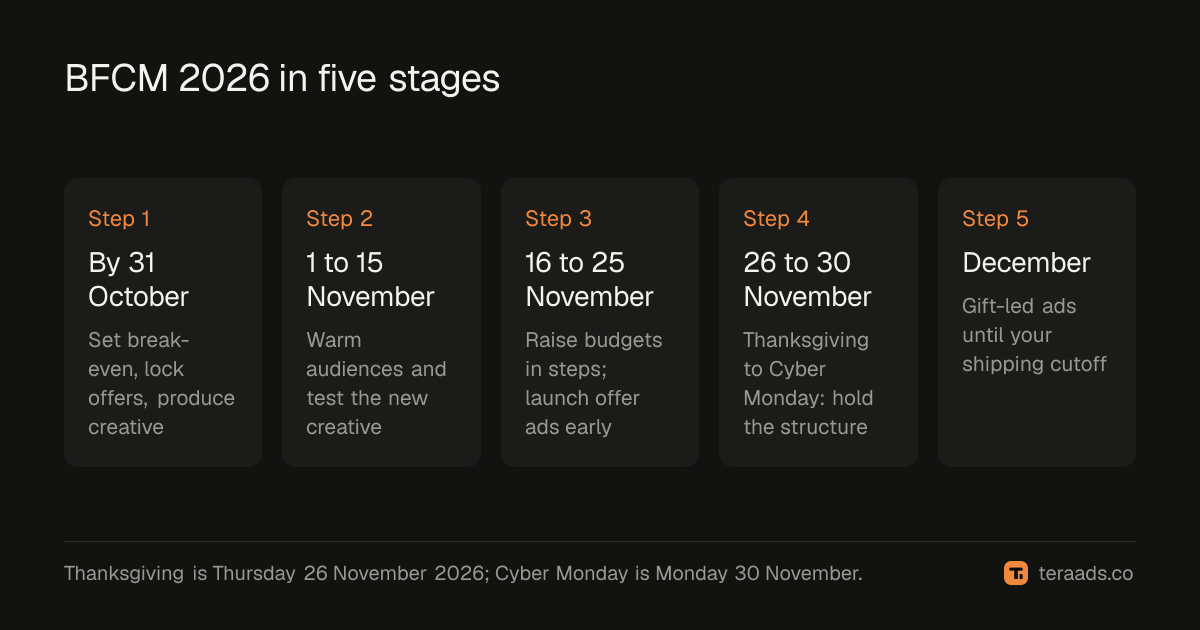
The plan, step by step
- Set your break-even before choosing an offer. Work out contribution per order at the price you'll actually charge: price minus product cost, shipping, payment fees and packaging. Divide 1 by that margin for your break-even ROAS. The break-even ROAS guide walks through it.
- Lock offers by 31 October. Decide the discount depth, which products are in, and whether bundles or a gift with purchase would cost less than a straight percentage off. The discount cost calculator shows what each option costs you.
- Finish creative by early November. Make Black Friday versions of your best ads: offer-led images, short videos and product sets for catalog ads. Untested creative launched on Thanksgiving learns when auctions are most expensive.
- Warm audiences from October to mid-November. Run prospecting that builds video viewers, Facebook and Instagram engagers and site visitors, and grow your email and SMS list with a promise of early access.
- Ramp budgets in steps from 16 November. Raise budgets on campaigns that already make money, in planned steps a few days apart. Scaling Meta budgets covers how big each step should be.
- Launch Black Friday ads before the day. Put the offer creative live a few days early, aimed at subscribers and warm audiences with early access, so delivery has settled before the busiest days.
- Run the five days on a schedule. Check spend, cost per purchase and frequency at set times each day. Swap creative when frequency climbs and click-through falls, not because one morning looks slow.
- Judge the weekend once refunds come in. Compare contribution after ad spend and refunds with a normal week, a few weeks after Cyber Monday.
What a discount does to your break-even
In the weeks around Black Friday, many more advertisers bid for the same people, so reaching them costs more. You can't control that. You can control how much room each order leaves you to pay for it.
Take an illustrative brand selling an $80 product. Product cost is $24. Shipping, payment fees and packaging come to about $12 an order. In a normal week each order leaves $44 of contribution before ads, a 55% margin. Break-even ROAS is 1 ÷ 0.55, about 1.82x, and the most it can pay for a purchase is $44.
At 25% off, the price drops to $60 but the product and shipping cost the same. Payment fees fall slightly with the price, which we ignore here. Contribution falls to $24, a 40% margin. Break-even ROAS rises to 2.5x and the break-even cost per purchase falls to $24, almost half.
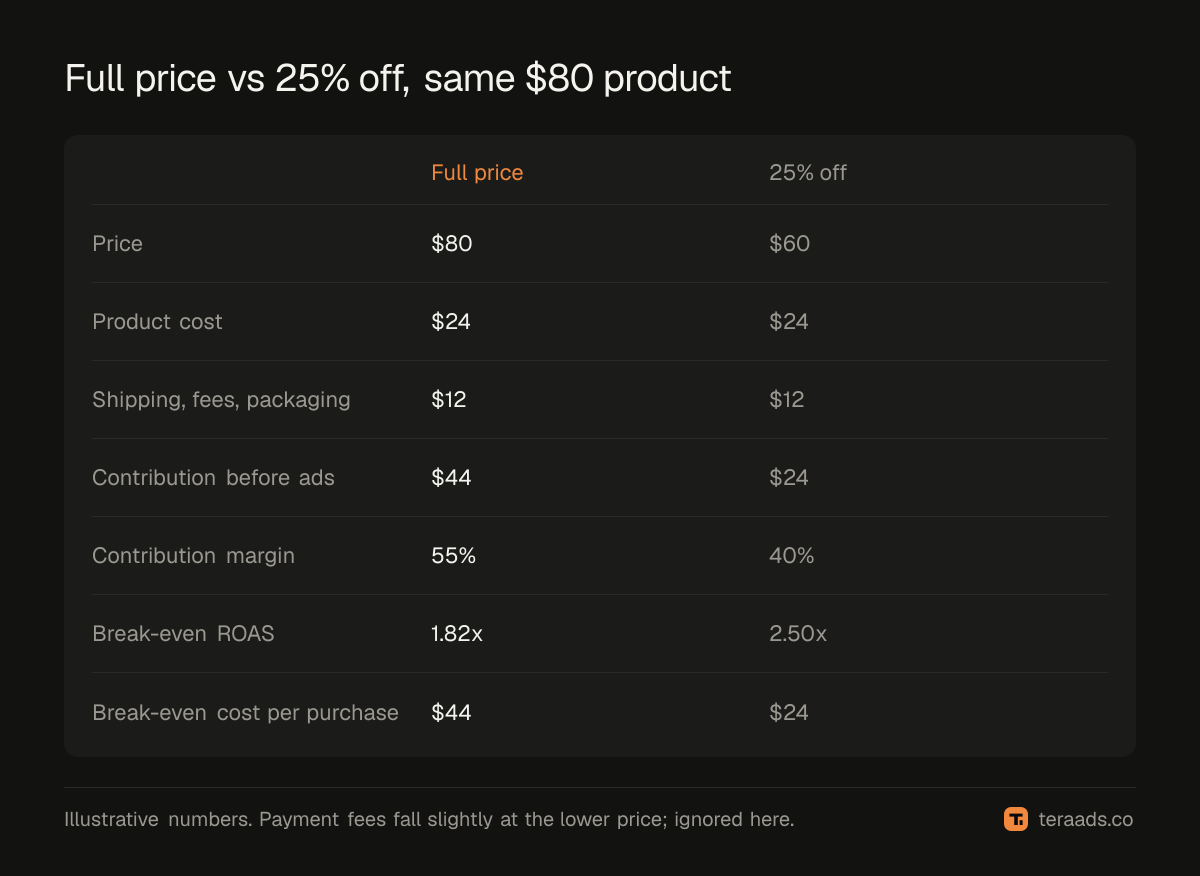
So a Black Friday campaign can show a higher conversion rate, a lower cost per purchase and a healthy-looking ROAS, and still make less money than a quiet week. If the normal cost per purchase is $30 and the sale brings it down to $22, profit per order still drops, from $14 to $2.
Two rules follow. Set the discount from the break-even, not from what competitors do. And keep some full-margin products in the mix: bundles, gift sets and new arrivals often sell in the peak without a deep discount.
Budget ramp and the learning phase
Meta says an ad set leaves the learning phase once it can deliver stably, which usually happens after about 50 results in the week after its last significant edit. It also says frequent budget changes can send an ad set back into learning (Meta Business Help Center). While an ad set is learning, results are less stable and usually cost more.
That shapes the ramp:
- Fewer, larger ad sets. Five ad sets that each get 15 purchases a week learn more slowly than one that gets 75. The learning phase guide explains why.
- Planned steps, a few days apart. Decide the dates in advance, for example 16, 19 and 23 November, then hold budgets steady through Cyber Monday.
- New ads early. Put Black Friday creative into ad sets that already convert by about 20 November, so delivery has days, not hours, to settle.
- A spending ceiling. Set the most you'll spend in November from your margin and fixed costs, then pace against it. The Q4 ad budget guide shows how to set it month by month.
Warming audiences in October and early November
Retargeting on Black Friday only works if there's someone to retarget. Use October and the first half of November to fill the pool:
- Video views. Short videos build audiences you can reach again in the peak.
- Site visitors. Prospecting with your best evergreen creative keeps new people arriving.
- An early-access list. Collect email and SMS sign-ups with a promise of first access to the sale. These are your cheapest Black Friday buyers.
- Frequency in check. Repeating the same ad to a small warm audience stops working; Meta ads frequency explains where the limit tends to be.
Warm audiences convert cheaply in the peak, but they include people who would have bought anyway. Don't let retargeting take the whole budget.
Judging the weekend on contribution margin
Platform ROAS looks its best on Black Friday, for two reasons. Meta and Google each count purchases they influenced inside their own attribution windows, and many BFCM buyers saw both. And neither takes refunds back out, so post-holiday returns never reach the number.
An illustrative brand spends $9,000 on Meta Ads and $3,000 on Google Ads over the five days. Meta reports 3.4x ($30,600) and Google 4.0x ($12,000). Together they claim $42,600, more than the $40,000 of net sales Shopify recorded. Here's what the weekend actually earned:
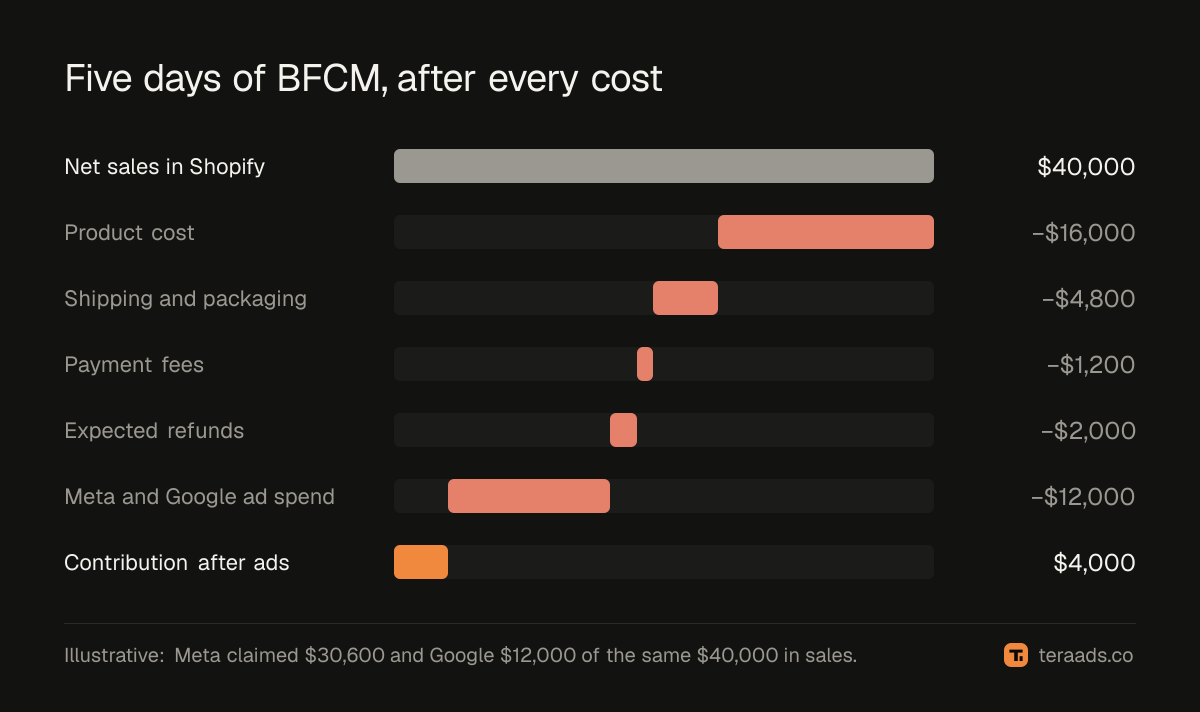
After product cost (40% of discounted sales), shipping and packaging, payment fees, an allowance for refunds and $12,000 of ads, the weekend leaves $4,000, or 10% of sales. Not a disaster, but nothing like what 3.4x suggests. Blended MER, total net sales divided by total ad spend, is $40,000 ÷ $12,000 = 3.33x. That's the number to plan next year on; MER vs ROAS explains why.
What to do the week after Cyber Monday
- Step budgets down; don't switch them off. Gift buying carries on into December. Move from discount creative to gift-led creative and gift guides.
- Respect the shipping cutoffs. Stop promising Christmas delivery once your carrier can't make it, and switch to gift cards.
- Refresh tired creative. BFCM ads run at high frequency and wear out fast; creative fatigue shows the signs.
- Mark the cohort as provisional. Refunds on BFCM orders arrive through December and January. Count them against the November orders they came from; true ROAS after refunds explains why.
- Write down what made money. Note which offers, creatives and audiences were profitable after refunds, not which had the best ROAS.
Common mistakes
- Doubling budgets on Friday morning. It risks sending ad sets back into learning on the most expensive day of the year.
- Launching all-new creative on Thanksgiving. Test it in early November instead.
- Choosing the discount before the break-even. A deep discount can turn a good conversion rate into no profit.
- Reading Ads Manager ROAS as profit. Two platforms claiming the same order is normal in the peak.
- Judging the weekend in the first week of December. Refunds haven't arrived yet.
Tera Ads works out profit for the whole store: Shopify sales minus product cost (from the margin you set, 70% by default), ad spend, shipping, payment fees, returns and refunds, with returns counted in the month the order was placed. It shows every Meta Ads and Google Ads campaign in one table with the ROAS each platform reports and the money-wasters marked, and Shopify orders arrive about a second after checkout, which helps on a busy weekend. It's free for one business, with no card needed.
Frequently asked questions
When should I start Black Friday ads on Meta?
Start preparing in October: break-even, offers and creative. Warm audiences from early November, and put the Black Friday offer ads live a few days before Thanksgiving so they've settled before the busiest days.
Should I create new campaigns just for Black Friday?
Usually not. New campaigns and ad sets start in the learning phase. Adding offer creative to campaigns that already convert, a few days early, lets you use what they've learned.
How much should I raise my Meta budget for BFCM?
As far as your margin allows and no further. Set a ceiling for the month from contribution, fixed costs and the profit you want to keep, raise budgets in planned steps, and stop when extra spend earns less than your break-even ROAS.
What ROAS do I need on Black Friday?
At least your break-even ROAS at the discounted price, which is higher than normal. In the example above, 25% off moves it from 1.82x to 2.5x on net sales before tax.
Why does Ads Manager show more revenue than Shopify on Black Friday?
Meta and Google each count purchases inside their own attribution windows, so an order a shopper reached through both gets counted twice. Use Shopify net sales and total ad spend (MER) for the weekend as a whole.
When can I tell whether BFCM made money?
Once most refunds are in. Wait until the orders are older than your return window plus a couple of weeks. With a 30-day window, that means checking November's orders in mid-January.