Q4 Ad Budget for Shopify: Set It From Break-Even ROAS and Margin
How to set an October to December ad budget from break-even ROAS and contribution margin, with a worked USD example by month and clear rules on when to stop scaling.
On this page
Set a Q4 ad budget month by month: forecast net sales, multiply by contribution margin, and subtract fixed costs and the profit you want to keep; what's left is the most you can spend on ads. Do it separately for October, November and December, because discounts change your margin and your break-even ROAS. Then spend up to that ceiling only while the next dollar of ads still earns more than break-even.
Key takeaways
- Each month's ad budget ceiling = forecast net sales × contribution margin − fixed costs − target profit.
- Discounts lower contribution margin, so November's break-even ROAS is higher than October's.
- Turn each ceiling into a minimum blended MER that total ad spend has to hit.
- The ceiling is a limit, not a target. Stop scaling when the return on extra spend falls below break-even.
- Pace spend inside each month around Black Friday, Cyber Monday and your shipping cutoffs.
Why Q4 needs its own budget
Three things change at once in the fourth quarter:
- Costs go up. More advertisers bid for the same shoppers, so reaching them costs more.
- Margins go down. Black Friday and holiday discounts take a slice of every order.
- Demand is uneven. Sales bunch around Black Friday and Cyber Monday and before the last delivery dates for Christmas, and refunds arrive in December and January.
A single rule such as "spend 20% of revenue on ads" misses all three. The profit-first ad budget explains the general method. This guide applies it to Q4, one month at a time.
The method, step by step
- Forecast net sales for each month. Start from gross sales and take off discounts and expected refunds. Leave sales tax and VAT out; sales tax and VAT in ROAS explains why. Use last year's Q4 and this year's trend.
- Work out contribution margin for each month. Net sales minus product cost, shipping, payment fees and packaging, as a share of net sales. Use the discounted prices you'll actually charge. The contribution margin guide lists what to include.
- Calculate break-even ROAS. Divide 1 by the contribution margin. It's the ROAS, on net sales, at which ads exactly pay for themselves.
- Subtract fixed costs and a profit target. Salaries, software, rent and agency fees, then the profit you want to keep that month.
- Set the ceiling and the minimum MER. What's left is the ad budget ceiling. Divide forecast net sales by the ceiling to get the minimum blended MER.
- Pace each month. Split the ceiling across weeks by expected demand, not evenly.
- Check marginal returns every few days. Keep raising spend only while the extra spend earns more than break-even.
A worked example by month
The numbers below are for an illustrative brand, not a customer. It sells physical products in the US, runs 25% off sitewide for Black Friday and Cyber Monday, and has $8,000 of fixed costs a month.
| Line | October | November | December | Q4 |
|---|---|---|---|---|
| Forecast net sales, excluding tax | $50,000 | $100,000 | $70,000 | $220,000 |
| Contribution margin before ads | 50% | 40% | 46% | 44.2% |
| Contribution before ads | $25,000 | $40,000 | $32,200 | $97,200 |
| − Fixed costs | $8,000 | $8,000 | $8,000 | $24,000 |
| − Target profit | $5,000 | $6,000 | $7,000 | $18,000 |
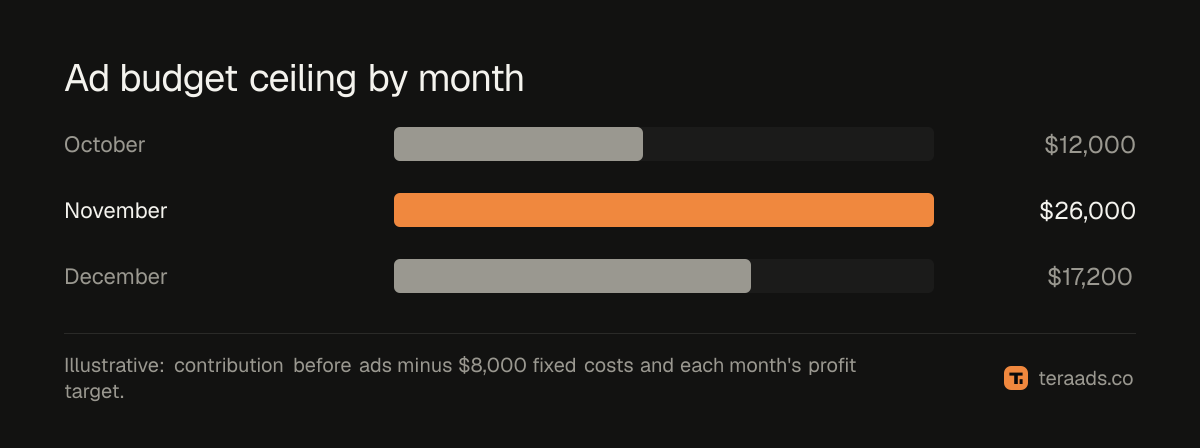
| Ad budget ceiling | $12,000 | $26,000 | $17,200 | $55,200 |
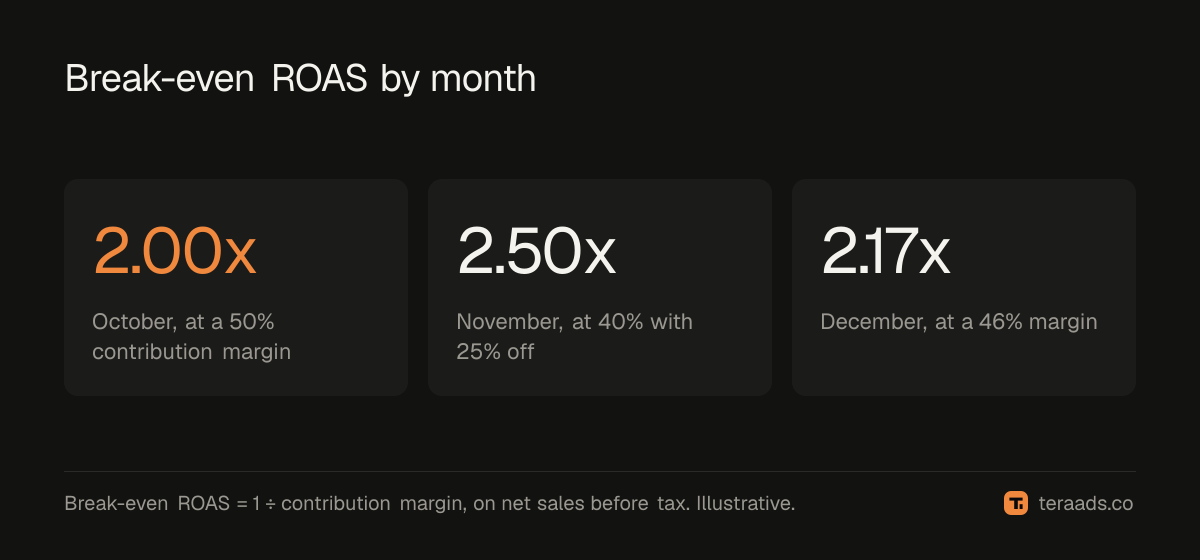
| Break-even ROAS (1 ÷ margin) | 2.00x | 2.50x | 2.17x | 2.26x |
| Minimum blended MER | 4.17x | 3.85x | 4.07x | 3.99x |
November has the biggest ceiling, and also the hardest test. At a 40% margin, every dollar of ads has to bring $2.50 of net sales just to break even, against $2.00 in October. December's margin recovers as the discounts end, but demand for physical gifts fades after the shipping cutoffs.
The minimum MER is total net sales divided by total ad spend. It includes sales the ads didn't cause, such as returning customers, email and organic search, so it sits well above break-even ROAS. If November's MER falls below 3.85x, the brand misses its profit target, even if every campaign shows a healthy ROAS in Ads Manager. MER vs ROAS covers the difference.
Revenue depends on spend, so test the forecast
The catch is that part of next month's sales comes from the ads you're budgeting. Split the forecast in two:
- Baseline sales arrive with little ad spend: returning customers, email and SMS, organic search. Estimate them from a quiet month.
- Ad-driven sales depend on how much you spend and what each extra dollar returns.
If the ad-driven part needs a return you've never reached at that spend, the forecast is too optimistic. Lower it and recalculate the ceiling. A ceiling built on a hopeful forecast just spends the profit faster.
Pacing inside each month
November's $26,000 isn't $867 a day. Demand is heaviest from Thanksgiving to Cyber Monday, so a pacing plan for the example looks like this:
| Period | Days | Daily budget | Total |
|---|---|---|---|
| 1 to 15 November | 15 | $400 | $6,000 |
| 16 to 25 November | 10 | $700 | $7,000 |
| 26 to 30 November, Thanksgiving to Cyber Monday | 5 | $2,600 | $13,000 |
| November | 30 | $26,000 |
Make these changes on planned dates, not every morning. Meta says frequent budget changes can send an ad set back into the learning phase, where results are less stable (Meta Business Help Center). The Meta budget scaling guide covers step sizes, and the Black Friday Meta Ads plan has a day-by-day calendar.
For December, plan around delivery. USPS recommends sending USPS Ground Advantage packages by 17 December and Priority Mail by 18 December for delivery by Christmas in the lower 48 states (USPS holiday shipping dates). After your last delivery date, spend should fall unless you sell gift cards or digital products.
When to stop scaling
The ceiling tells you the most you can spend. Marginal returns tell you when to stop before you reach it. Each time you raise spend, compare the extra net sales with the extra spend.
In the week of 16 November, the illustrative brand tries $900 a day instead of the planned $700. Daily net sales rise by $420 on average. The marginal ROAS is $420 ÷ $200 = 2.1x, below November's 2.5x break-even. The extra $200 a day brings $420 × 40% = $168 of contribution, so it loses $32 a day. The brand goes back to $700.
Stop scaling, or step back, when any of these happen:
- Marginal ROAS falls below the month's break-even. Extra spend is buying sales at a loss.
- Blended MER stays below the minimum for several days. The month's profit target is slipping.
- Frequency rises while click-through falls. The creative is tiring; creative fatigue shows what to look for.
- The ceiling is reached. Anything more comes out of profit.
- The shipping cutoff has passed. Gift buyers who can't get delivery by Christmas won't buy physical products.
Scaling ad spend profitably explains how to measure marginal returns without fooling yourself with a single good day.
Refunds land in December and January
Q4 orders come back later than most. Gifts get returned after the holidays, and many stores extend their return windows for the season. Build the expected refund rate into each month's net sales forecast up front, then count actual refunds against the month the order was placed. If you book them when they're processed, November looks better than it was and January looks worse. True ROAS after refunds shows how to match them up.
Common mistakes
- One margin for the whole quarter. November's discounts deserve their own break-even.
- Budgeting from platform ROAS. Meta and Google can both claim the same order. Plan on Shopify net sales.
- Treating the ceiling as a target. Spend only while the extra spend still earns more than break-even.
- Spreading Black Friday spend evenly across November. Most of the demand sits in five days.
- Forgetting fixed costs. Contribution after ads still has to pay the team and the tools.
Tera Ads shows Shopify sales, Meta Ads and Google Ads spend, and the store's profit after product cost, shipping, payment fees, returns and refunds on one screen, so you can check MER and profit against the plan as each month goes. Meta spend updates every 30 minutes and Google Ads hourly. Every campaign from both platforms sits in one table with the ROAS each platform reports and the money-wasters marked. It's free for one business, with no card needed.
Frequently asked questions
How much should I spend on ads in Q4?
No more than each month's contribution before ads, minus fixed costs and your profit target, and only while extra spend stays above break-even. In the example, that's $12,000 in October, $26,000 in November and $17,200 in December.
How do I calculate break-even ROAS for Black Friday?
Work out contribution margin at the discounted price, after product cost, shipping, payment fees and packaging, then divide 1 by it. A 40% margin means a break-even ROAS of 2.5x on net sales before tax.
What is a good MER for Q4?
One at or above the minimum you calculated from your own ceiling: net sales divided by the most you can spend. There's no universal number, because it depends on margin, fixed costs and how much of your revenue comes without ads.
Should I spend my whole Q4 budget?
Only if extra spend keeps earning more than break-even. If marginal returns drop first, stop there and keep the difference as profit.
When should I start raising ad spend for the holidays?
Build audiences and test creative in October at normal budgets, then raise budgets in steps from mid-November, a few days apart, so ad sets have settled before Thanksgiving.
How should I budget for December after the shipping cutoff?
Plan most of December's spend for the days before your carrier's last recommended send date. After that, cut back unless you sell gift cards, digital products or offer local pickup.