How Much Do Google Ads Cost? What a Sale Costs a Shopify Store
Google Ads costs what you budget, but each sale costs your cost per click divided by your conversion rate. What drives both, and how to work out what you can afford.
On this page
Google Ads costs whatever budget you set: you choose an average daily budget, and Google spends up to it across the month. Search and Shopping ads are mostly paid per click, so what a sale costs is your cost per click divided by your conversion rate. Two stores spending $1,000 can pay $20 or $100 per sale, depending on what people searched and how well the store converts. Your store can afford any cost per sale below what an order leaves after product cost, shipping, fees and returns.
Key takeaways
- You set an average daily budget. Google can spend up to twice it on a busy day but keeps the month within the daily budget × 30.4.
- Search and Shopping ads are mostly charged per click, and you usually pay less than your maximum bid.
- Cost per sale = cost per click ÷ conversion rate. Search intent and the store matter as much as the bid.
- Searches for your own brand are cheap and convert well, but many of those buyers were coming anyway.
- The most a sale may cost is what an order leaves after product cost, shipping, payment fees and returns.
How Google Ads pricing works
Every search runs an auction among the advertisers whose ads match it. Google ranks ads by more than the bid: the quality and relevance of the ad and landing page, and the context of the search, count too. A highly relevant ad can win a higher position for less than a weak one.
On Search and Shopping, you pay when someone clicks, and the actual cost per click is often below your maximum bid, because you pay roughly what it takes to beat the ad ranked below yours. Most Shopify stores let Google set bids automatically, with "maximize conversion value" or a target ROAS, so the bid changes with each auction.
Budgets are set as an average per day. On some days Google can spend up to twice that average for most campaigns, then balances it so the month's spend stays within the daily budget × 30.4, the average days in a month. Google Ads limited by budget explains what to do when campaigns hit that limit.
What makes Google Ads cost more
| Factor | Costs rise when | What you can do |
|---|---|---|
| Search terms | Generic, competitive terms like "gold necklace" | Bid more on specific product searches; add negatives for waste |
| Brand vs non-brand | Most clicks are non-brand, where competition is real | Measure brand separately; judge non-brand on its own |
| Season | Black Friday and the holidays bring more bidders | Plan budget and offers ahead; expect higher clicks |
| Ad and page quality | Ads and landing pages don't match the search | Match titles and pages to the search; improve feed titles |
| Location and device | You target costly markets or mix devices that convert differently | Check results by country and device before adjusting |
| Conversion tracking | Duplicates or missing purchases mislead automated bidding | Keep one primary purchase action with the right value |
Same budget, five times the cost per sale
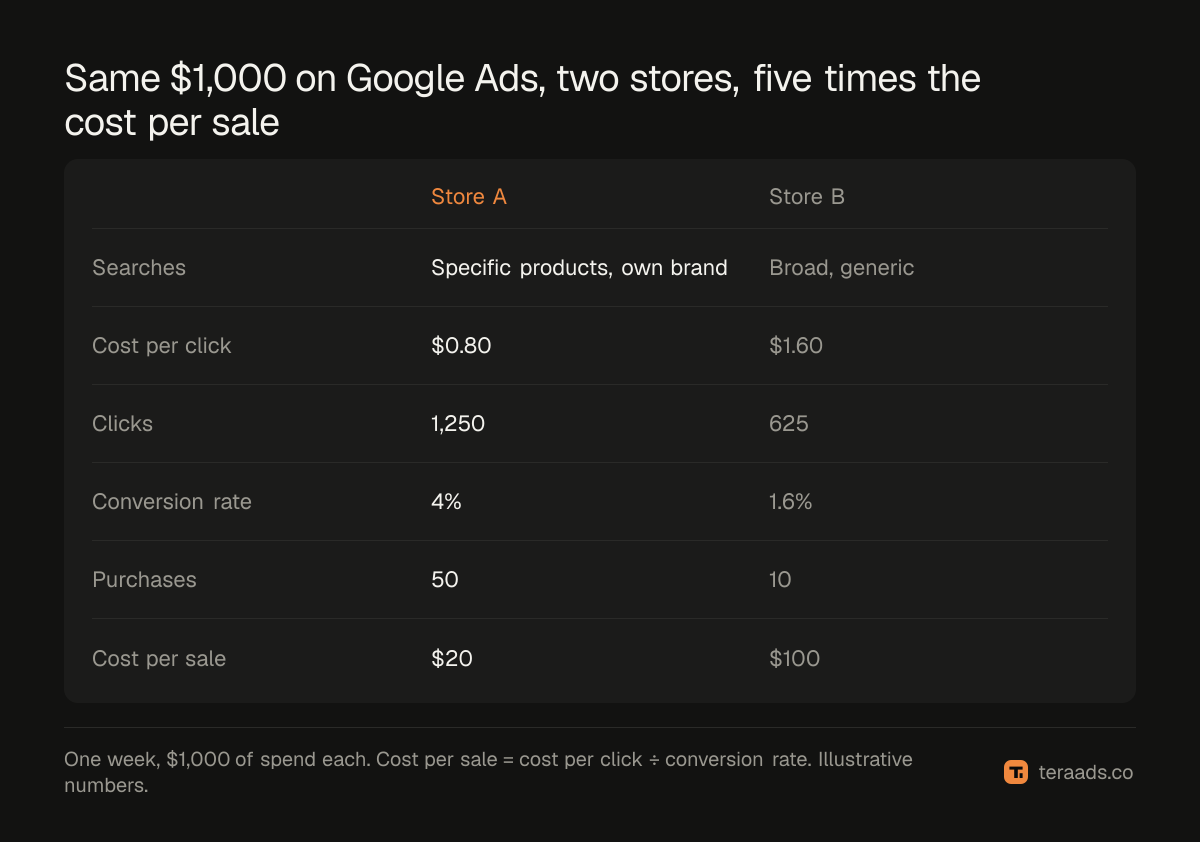
Two illustrative stores each spend $1,000 on Google Ads in a week:
- Store A gets most clicks from specific product searches and its own brand. It pays $0.80 a click and converts 4% of visitors: 1,250 clicks, 50 purchases, $20 per sale.
- Store B bids on broad, generic searches. It pays $1.60 a click and converts 1.6%: 625 clicks, 10 purchases, $100 per sale.
Cost per sale = cost per click ÷ conversion rate
Store A: $0.80 ÷ 0.04 = $20. Store B: $1.60 ÷ 0.016 = $100. Before celebrating Store A, check how much of its value came from people searching its name; brand vs non-brand search shows how to split it out, because many of those buyers would have ordered anyway.
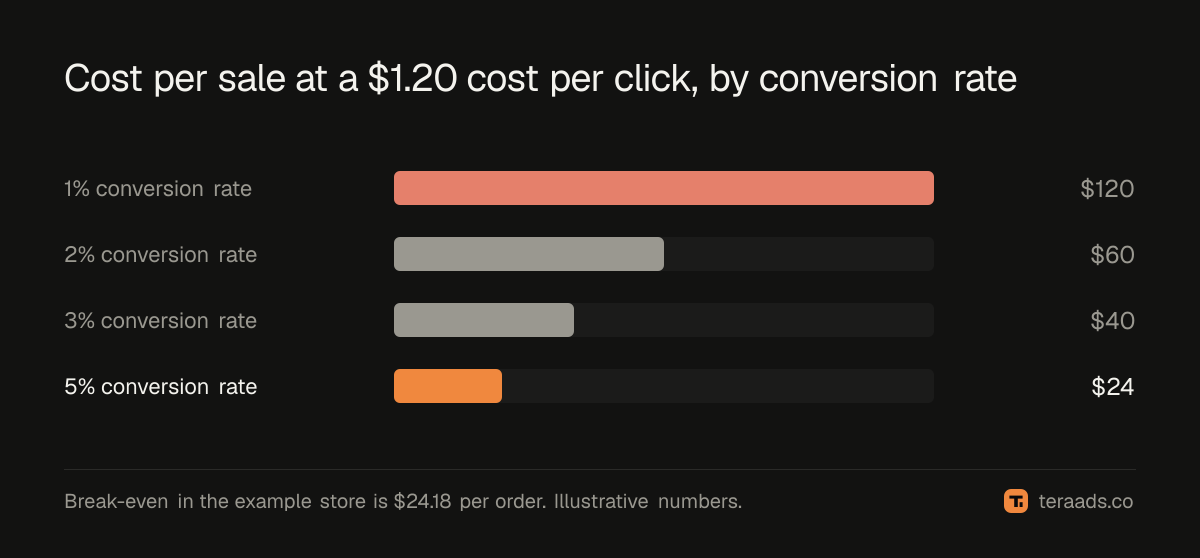
The conversion rate moves cost per sale as much as the click price does. At a $1.20 click, converting 1% of visitors means $120 per sale; converting 5% means $24. Shopify conversion rate shows where visitors drop off.
What a sale can cost your store
The limit is what an average order leaves after every cost that comes with it. In the illustrative store used across these guides, orders average $60, products cost 40% of the price, payment fees are 3%, shipping is $6 each way and 10% of orders come back. Each order placed leaves $24.18 to pay for ads.
- At Store A's $20 per sale, each order makes about $4 after ads, if the sales were really added by the ads.
- At Store B's $100 per sale, each order loses about $76.
Written as ROAS, the same limit is $60 ÷ $24.18 = 2.48x. Set a target ROAS above it, as target ROAS bidding explains, and judge results on Shopify orders after returns, because Google counts the order when it is placed and keeps refunds in the value it reports. Why your Google Ads aren't profitable has the full set of checks.
How much to spend when you start
Automated bidding learns from conversions, so a new campaign needs enough budget to bring a steady flow of purchases. Start with "maximize conversion value" without a target, run it for a few weeks, then set a target ROAS near what it achieves and above break-even.
Shopping and Performance Max usually suit stores better than Search alone, because the ads show the product, price and image. Google Ads vs Meta Ads for Shopify compares where each platform's budget works best, and how much Facebook ads cost shows the same sums for Meta.
How to lower what each sale costs
- Cut wasted searches. Open the search terms report and add negative keywords for searches that never buy. Wasted search terms shows where to start.
- Fix the feed. Clear titles, the right attributes and approved products put Shopping ads in front of the right searches. Google Shopping titles covers the common fixes.
- Raise conversion rate. Fast product pages, clear shipping costs and an easy checkout lower cost per sale without touching bids.
- Fix tracking. Doubled or missing purchases make automated bidding chase the wrong clicks. Conversion tracking for Shopify shows the setup.
Tera Ads connects Shopify, Google Ads and Meta Ads, and shows every campaign from both platforms in one table with the ROAS each platform reports, beside your store's profit after product costs, ad spend, shipping, payment fees, returns and refunds. It is free for one business.
Frequently asked questions
How much do Google Ads cost per month?
As much as you budget. Google spends up to the average daily budget × 30.4 in a month, though a single day can reach twice the daily budget. What matters is whether each sale costs less than an order leaves after costs and returns.
How much does a click cost on Google Ads?
It depends on the search, the competition and the quality of the ad and page. Specific product and brand searches tend to cost less than broad, competitive ones. You usually pay less than your maximum bid.
Are Google Shopping ads cheaper than Search ads?
Not always per click, but Shopping ads show the product, price and image, so the people who click are often closer to buying. Compare cost per sale on Shopify orders, not the price of a click.
What is a good cost per sale on Google Ads?
Any cost per sale below what an average order leaves after product cost, shipping, payment fees and returns. If an order leaves $24, a cost per sale under $24 is profitable on the first order.
Why are my Google Ads so expensive?
Usually broad searches that rarely buy, a weak feed, a low conversion rate on the store or tracking that misleads automated bidding. Check the search terms report and conversion tracking before raising or cutting budget.
Can I run Google Ads with a small budget?
Yes, but automated bidding learns slowly with few conversions. Put a small budget into one Shopping or Performance Max campaign rather than splitting it across several.